
Dr. Lutheran M. Carter IV
This portfolio was created to demonstrates my ability to describe and analyze learning theories. My portfolio includes descriptions, strengths, limitations, and implications of various learning theories in teaching and learning.
Comparing Learning Theories
Behaviorism
According to Vannack (2012), it is a school of thought that places significance on the role of experience in governing behavior in a way that initiates the behavior and includes specific behavior by the instructor that motivates the learner through interaction within the environment. To illustrate, behaviors within the classroom can be learned through conditioning and reinforcement such as rewards and punishments with is similar to the transactional leadership component of Bass and Avolio’s (2004) full-range leadership model (Mekonnen, 2004).
Strengths: Behaviorism can create a foundation of healthy and production organizations. For example, instructors can apply behavioral techniques to facilitate learning by enhancing learners’ understanding (Peel, 2005). Another pro is learning objectives during the instructional process (Ng’andu et al., 2013). Additionally, instructors can create a favorable environment for learners (Ng’andu et al., 2013).
Limitations: The entire process that occurs with the learners’ mind is not entirely considered, mainly concerning the stimuli and how learners respond (Strauch & Omar, 2014). However, role modeling, goal setting, and self-reinforcement can help learners achieve the required goals (Peel, 2005).
Implications: The goal of behaviorism-focused instructional design is eLearning must provide learners with appropriate stimuli. To illustrate, the instructional design must provide opportunities that assist learners in demonstrating that they can express the desired behaviors that prove that learning has occurred (Keramida, 2015).
References
Bass, B., & Avolio, B. (2004). Multifactor leadership questionnaire: Manual and sample set. (Technical Report). Redwood City, CA: Mind Garden Inc. https://www.mindgarden.com/multifactor-leadership-questionnaire/234-mlq-trainers-guide.html?search_query=multifactor&results=32
Keramida, M. (2015). Behaviorism in instructional design for eLearning: When and how to use it. eLearning Industry. https://elearningindustry.com/behaviorism-in-instructional-design-for-elearning-when-and-how-to-use
Mekonnen, W. (2020). Review on behaviorist approach and the construction of knowledgehttps://10.14662/IJELC2020.125
Ng’andu, K., Hambulo, F., Haambokoma, H., & Tomaida, K. (2013). The contribution of behaviourism theory to education. Zambia Journal of Education, 1(4), 58-74.
Peel, D. (2005). The significance of behavioural learning theory to the development of effective coaching practice. International Journal of Evidence Based Coaching and Mentoring, 3(1), 18-28. https://doaj.org/article/b7c99d948ee84c9e922e1f2628d15710
Vannack, H. (2012). The application of behaviourism in the classroom in primary and secondary schools. (). https://www.researchgate.net/publication/345397887_The_Application_of_Behaviourism_in_the_Classroom_in_Primary_and_Secondary_Schools
Strauch, C. C., Muaed, J., & Alomar. (2014). Critical analysis of learning theories and ideologies and their impact on learning evaluation of hospital admission criteria for community acquired-pneumonia patients at a private hospital in UAE view project
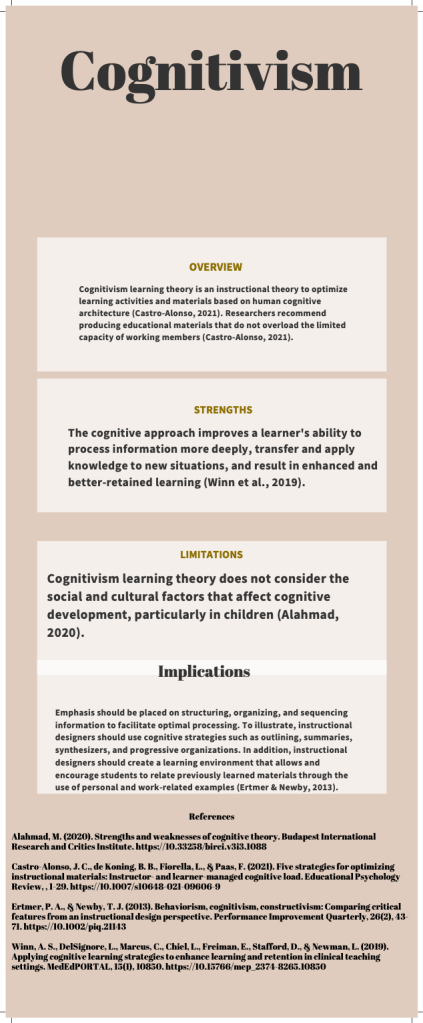
Cognitivism
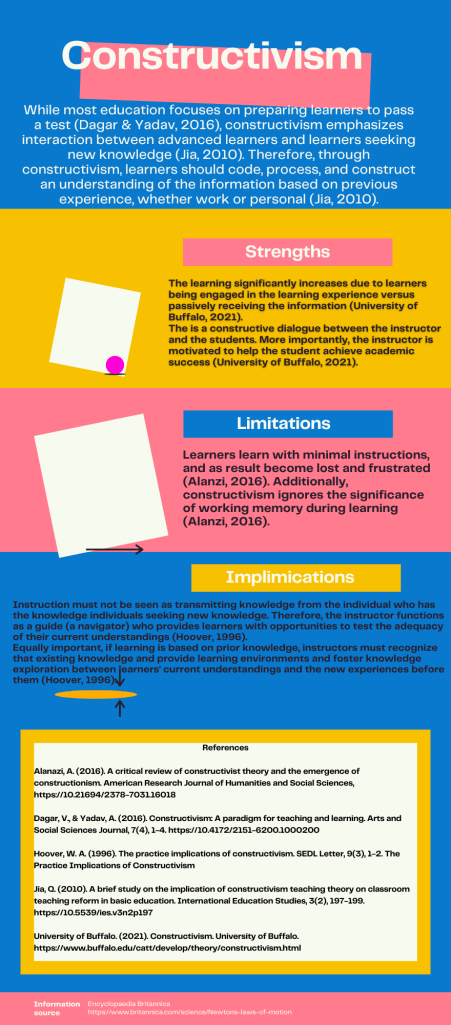
Constructivism
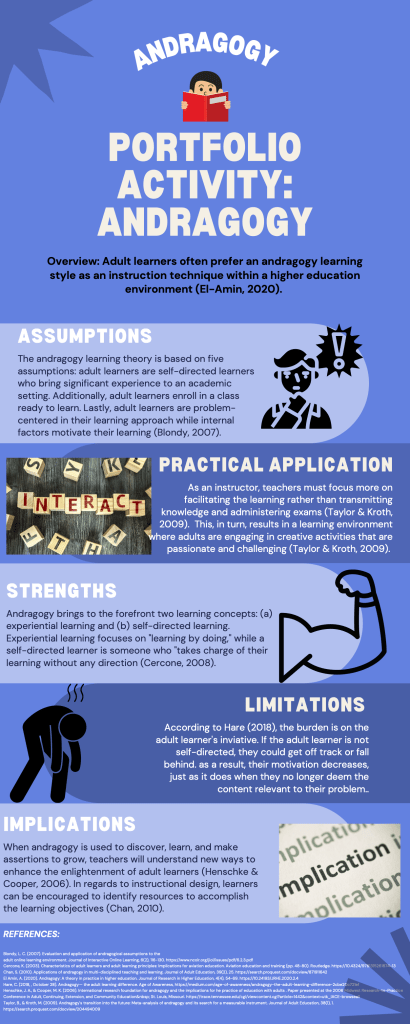
Andragogy
PERSONAL Experiences
Elementary School
when I was in elementary school, we were tasked with writing a book report. My topic was Marco Polo, an Italian explorer, and merchant. Who was teaching you this topic in elementary or middle school? Ms. Larkin was my 5th-grade teacher. How did you learn the information? I knew the data by checking out a book on Marco Polo. We had three weeks to read the book and provide a written and oral presentation. What type of information/skill were you learning? For example, was its information/content, such as history or company policies, or a skill, such as using Microsoft Word? We were learning about history; the skills we were expected to utilize were handwriting and speaking skills. Why were you learning the information or skill? It was a part of the mandatory curriculum for Richmond County.
College
Dr. D. Taylor from Southern Illinois University. How did you learn the information? In a classroom setting on the weekends. What type of information/skill were you learning? For example, was its information/content, such as history or company policies, or a skill, such as using Microsoft Word? Instructional skills using Microsoft Word. Why were you learning the information or skill? We learned this information because it was part of the Workforce Education and Development curriculum, emphasizing Training and Development.
2009 – 2012
Professional Experience
The topic we were learning in a professional setting was Leadership Continuum. Who was teaching you this topic in a professional setting? A conglomerate of senior enlisted leaders. How did you learn the information? In a classroom setting, lecture style. What type of information/skill were you learning? For example, was its information/content, such as history or company policies, or a skill, such as using Microsoft Word? We were learning leadership skills in the form of PowerPoint Lectures. Why were you learning the information or skill? I was learning this information because I was recently promoted to the rank of E-4.
Authentic Assessment
Learning Scenario: The learning scenario to be taught would utilize experiential learning. Which is considered “learning by doing.” In other words, learning should be recognized as a process rather than achieving outcomes. Therefore, to enhance the learning of adult learners, the focus should be on engagement as a process that enhances their learning. This can be achieved by providing feedback on the effectiveness of their efforts (Kolb & Kolb, 2009). The scenario would focus on Navy History. Instead of reading a bunch of books on Naval History. I would task the adult learners to visit the USS Midway Museum to learn the vessel’s history and visit ships in the area to learn about previous battles those ships engaged in during World War I and II. During the course, each learner would engage in group discussions, share their observations of what they learned and acquire knowledge and facts from other learners.
Authentic Assessment: For their authentic assessment, the learner would create a video (using ScreenCast or PPT video) to share what they have learned regarding the USS Midway or any other Navy vessel. They would be encouraged to use graphics, music, and storytelling. This assessment is student-centered and authentic because it allows the adult learner to decide how to present the video, which is more meaningful and worthwhile. This ties into the experiential learning model because it allows the adult learner to engage in the assessment actively. As a result of “doing” the assessment using video, they are still learning.
Connection to Learning Theory: This design is connected to andragogy. Andragogy encourages collaborative learning in the classroom. As a result, adult learners better understand and retain facts more effectively because adult learners are allowed to participate in gathering and formulating the information (El-Amin, 2020).
References
El Amin, A. (2020). Andragogy: A theory in practice in higher education. Journal of Research in Higher Education, 4(4), 54-69. https://10.24193/JRHE.2020.2.4
Kolb, A. Y., & Kolb, D. A. (2009). Experiential learning theory: A dynamic, holistic approach to management learning, education, and development. The SAGE handbook of management learning, education, and development (pp. 42). SAGE Publications Ltd. https://10.4135/9780857021038.n3
Comparing
Learning Theories
MicroLearning
Project
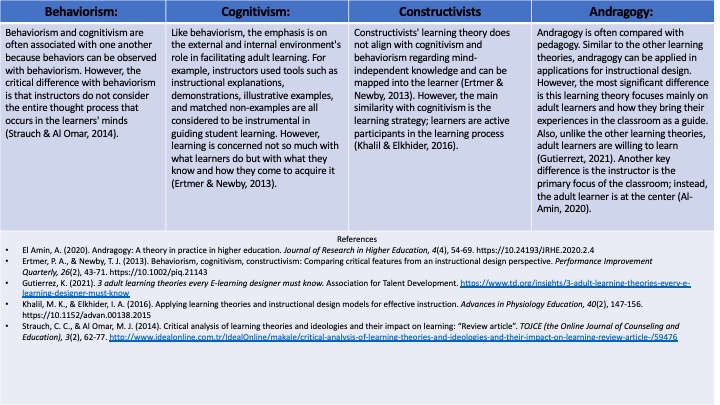
For the MicroLearning Project, the goal was to create modules that only focused on one learning objective. For example, module one focused on providing an overview of each learning theory using an infographic. The infographic was created using Canva. For this MicroLearning Project, I utilized articulate 360. I chose Articulate 360 because it is a tool I have already used in a previous class, and I found the tool useful for this course. Finally, as a backup, I used ScreenCast to record the presentation of my portfolio. In this MicroLearning Project, I created infographics to provide an overview of each learning theory while using PowerPoint to create a charter that compared each learning theory to the other. The duration of the Microlearning Project should be between 3-5 minutes (Morrison, 2017).
Additionally, each section should only address one objective. For the first module, the objective was to provide an overview of each learning theory and the differences and similarities. The second module focused on the principles of andragogy. Regarding accessibility, the microlearning course is accessible through a quick google search and a link that can be accessed through the phone.
Reflection: This experience has expanded my thinking on how learners retain knowledge and how the instructor engages their learners. For me, the primary learning theory principle I utilized was andragogy learning theory. For example, this course used an experiential learning approach where I “learned by doing.” Focusing on the four stages in the experiential learning cycle:
Concrete experience – concrete experience came from the current challenge I was experiencing: understanding how to use all of the e-learning technology. This was a challenge; however, I was able to gain substantial experience.
Reflective observations – I reflected on my past and present observations to determine a way forward to complete the final portfolio project.
Abstract conceptualization – I was able to develop ideas based on my reflective observations.
Then active experimentation to validate my ideas.
My most significant aha moment was with the andragogy learning theory. As an adult learner and a college professor, I could connect with this theory more than any other theory because my pursuit for higher learning did not begin until I was an adult.
Microlearning Link: https://rise.articulate.com/share/K9QfmwopxJgPZil3zumVelqM4pK5PCgq
Let’s make something together.
 Portfolio